
Beyond Survival
Nervous Systems, Ritual, Embodied Safety, and the Future of Human Becoming

Author’s Note
This text emerged through a series of dialogues and encounters around systems transformation, embodiment, ecology, mindfulness, ritual, regeneration, and the development of consciousness. It is not written as a scientific paper, nor purely as philosophy. It is A songline, an attempt to follow one central question through many layers of experience:
What kind of world do nervous systems create when they no longer feel existentially safe?
And what becomes possible when enough embodied safety returns for imagination, relational intelligence, and participation in life to emerge again?
Many of these reflections are woven through my recent work, conversations, and books — especially Wild & Wunderbar, which explores neuroregulation, burnout, feminine consciousness, thresholds, and the dissolution of identity structures during times of transition, and in Alchemy of Soul, which moves through transformation as lived inner passage rather than abstract self-development.
This text is also deeply informed by my own embodied experiences with horses, somatic work, Continuum Movement, ecology, systems thinking, and years of listening to people standing at thresholds of change. Thank you for reading.
A living inquiry into regulation, imagination, ecology, and the systems we create
-By Cordula Frei
Modern civilization increasingly organizes around chronic nervous system activation: acceleration, uncertainty, overstimulation, fragmentation, optimization, and disconnection from communal and ecological forms of belonging. This article explores the relationship between nervous system regulation, perception, ritual, imagination, and systems creation.
Moving between embodiment research, ecology, rites of passage, relational intelligence, and cultural transformation, I like to engage on the question, whether many of today’s crises are not merely political, ecological, or psychological — but rooted in collective states of survival organization.
At the center lies one question:
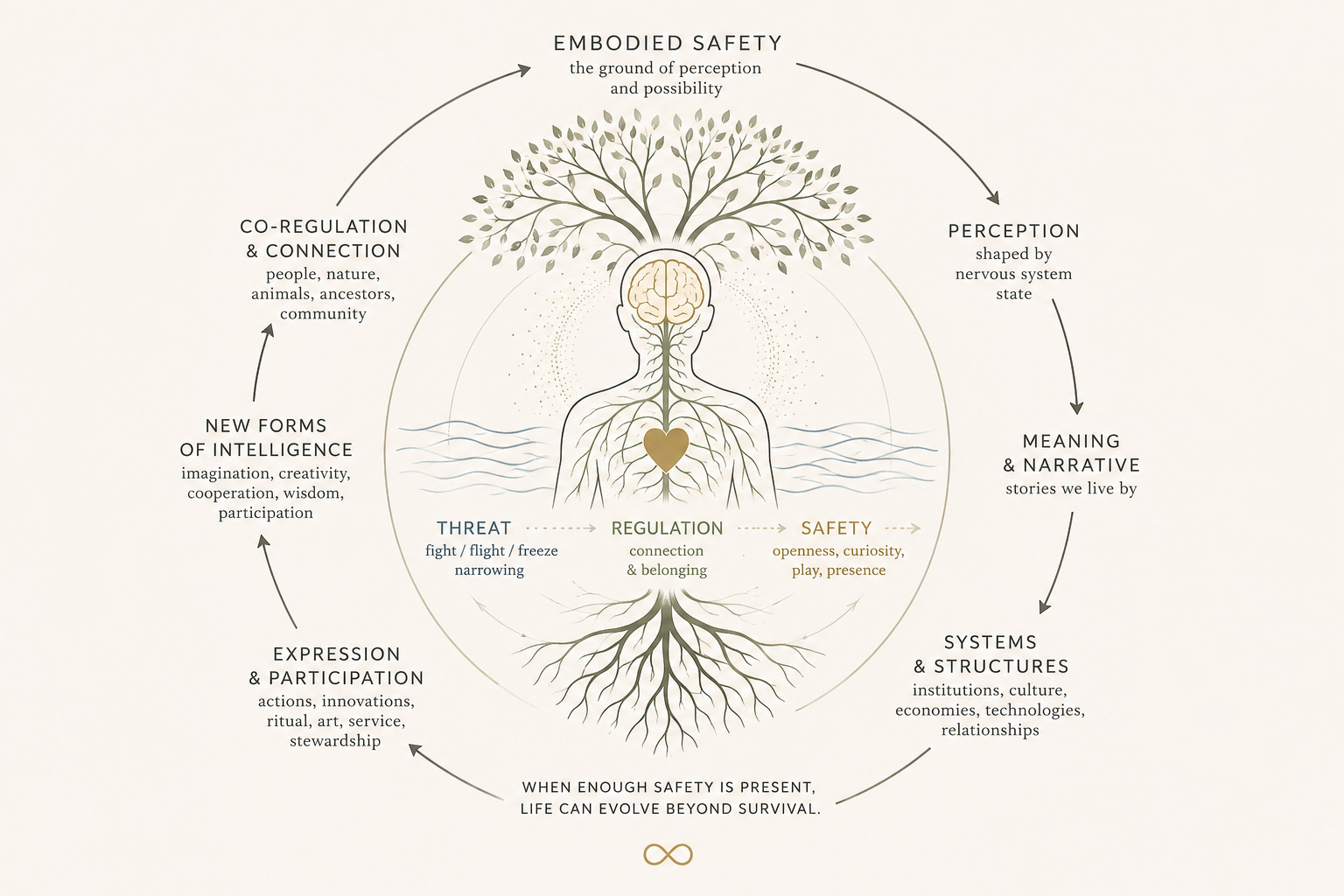
If nervous systems shape perception, and perception shapes systems, what kinds of futures become possible when humanity rediscovers embodied safety, relational coherence, and participation in life?
I keep circling around this line because it feels less like an idea and more like an orientation point for understanding our time.
What if many of the systems humanity keeps recreating are not primarily ideological, but much more physiological as we are aware of ?
If our economies, institutions, technologies, relationships, and even our ideas of progress are shaped by nervous systems organized around chronic survival activation, how much freedom is there: even if we think we act informed, intelligent and by free will ?
What if many of our attempts to “heal” (or to create a “better”) world (and our selves) still emerge from the same field of threat they are trying to escape since time and time over time, repeating the same loop?
These questions became especially alive for me through my work with horses.
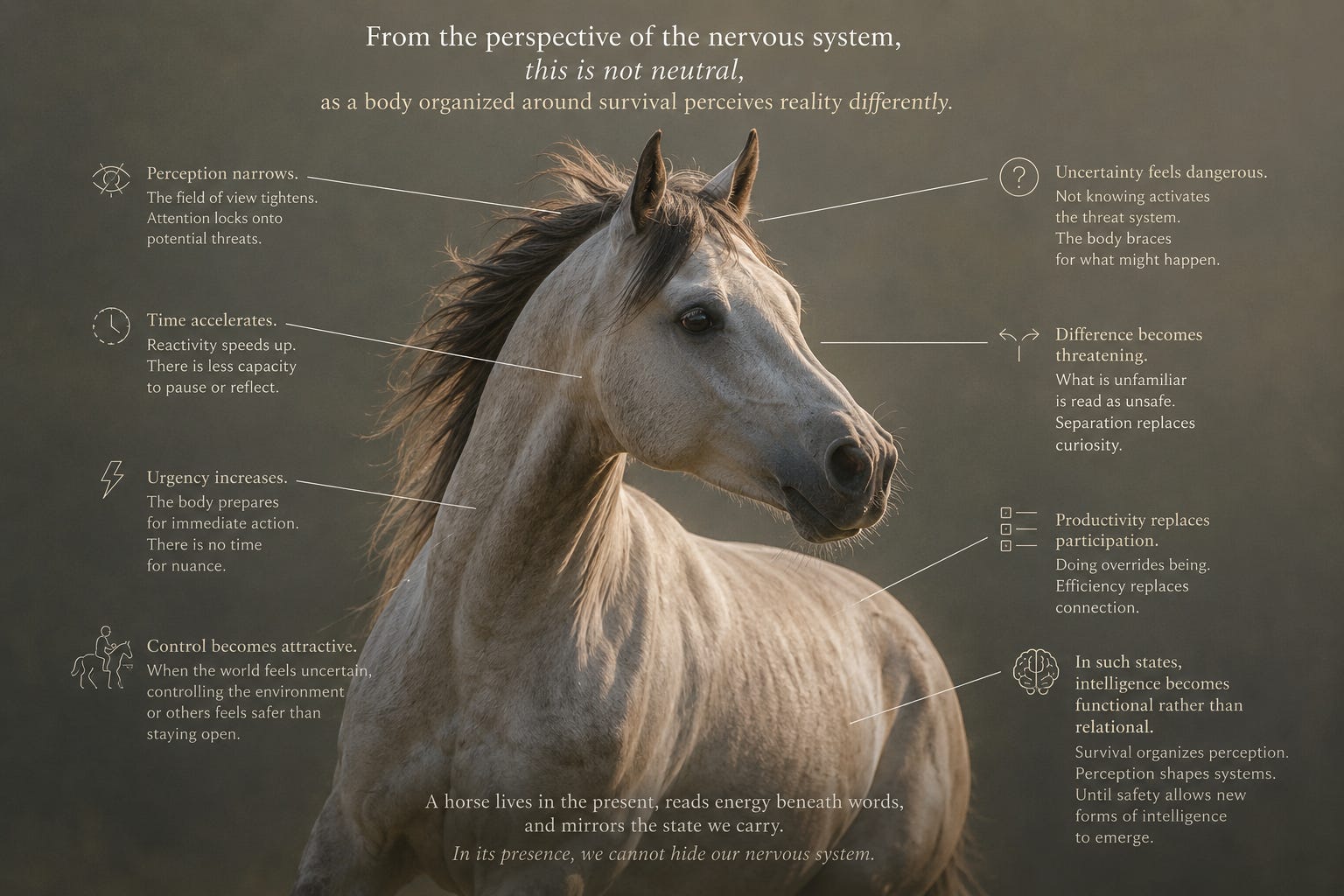
A horse cannot be negotiated with conceptually. It does not respond primarily to language, performance, identity, or self-image. It responds directly to nervous system coherence.
I have often experienced moments where I believed I was calm while my body was still subtly contracted, accelerated, bracing, performing, or anticipating. The horse always knew before I did.
What the horse meets is not narrative, it meets regulation.
This creates a radically honest relational field.
In many ways, horses became one of my deepest teachers in understanding that nervous systems constantly communicate beneath cognition. Safety, trust, tension, fear, openness, and presence are transmitted long before words appear.
And perhaps this is true not only between humans and animals, but within whole cultures.
Perhaps civilizations themselves are expressions of nervous system states.
Much of modern life appears organized around low-grade survival activation:
constant stimulation,
information overload,
economic pressure,
identity insecurity,
social fragmentation,
hyper-productivity,
future anxiety,
optimization culture,
and the subtle feeling that one must continuously manage, improve, secure, or defend oneself.
From the perspective of the nervous system, this is not neutral, as a body organized around survival perceives reality differently.
Perception narrows.
Time accelerates.
Urgency increases.
Control becomes attractive.
Uncertainty feels dangerous.
Difference becomes threatening.
Productivity replaces participation.
In such states, intelligence becomes functional rather than relational.
This may explain why modern culture often struggles to imagine futures beyond extraction, competition, or collapse. A nervous system in survival mode does not easily access curiosity, creativity, imagination, or ecological participation because survival narrows the field of possibility.
And yet life itself evolved through far more than survival.
At some point in evolution, something extraordinary happened:
life began playing.
Birds developed songs beyond strict function.
Whales created vast acoustic worlds.
Humans painted caves, danced around fires, entered ritual, invented mythologies, poetry, symbols, initiation rites, music, and cosmologies.
Forests evolved symbiotic intelligence.
Coral reefs became ecosystems of relational complexity.
Beauty appeared everywhere in nature with astonishing excess.
Life did not only adapt, life also expressed.
This raises an important question which i so often contemplate about, did evolution move only through pressure and survival?
Or did entirely new forms of intelligence emerge once enough safety allowed exploration beyond immediate threat?
I do not believe safety is the endpoint of evolution, but I increasingly sense that without enough embodied safety, consciousness cannot stabilize beyond defensive organization.
Pressure may trigger adaptation, but safety allows participation.
This distinction matters enormously.
A nervous system overwhelmed by threat may become hyper-efficient, but not necessarily wise. Trauma can sharpen vigilance while simultaneously reducing imagination.
This is one of the paradoxes I explored deeply in my book Wild & Wunderbar:
Burnout is not always collapse from weakness, but often the consequence of prolonged adaptation to environments that continuously override the body’s deeper rhythms and thresholds.
At a certain point, cognition itself begins dissolving, meaning fragments and the nervous system loses orientation. In this manner, identity structures destabilize.
In my research and many interviews i held with women in the threshold of menopause and burnout, fatigue or post-covid dissonance i came to understand, that this is not pathology alone.
Many people are carrying forms of cognitive and emotional exhaustion because modern culture increasingly asks nervous systems to self-regulate into conditions that were never evolutionarily relational enough to support human thriving.
Traditional cultures understood something modernity often forgot:
Human transformation requires communal regulation.
Ritual is one way of returning to belonging. It was never merely symbolic decoration.
Ritual functioned biologically, emotionally, socially, ecologically, and spiritually at once.
Rites of passage helped carry nervous systems through existential thresholds:
birth,
puberty,
grief,
partnership,
death,
initiation,
becoming.
The individual was not expected to cross thresholds alone.
Community held the transition.
Nature held the transition.
Story held the transition.
Rhythm held the transition.
Without such containers, transformation easily becomes fragmentation.
I sometimes wonder whether modern societies are experiencing a civilization-wide initiation crisis. We have largely lost rituals capable of metabolizing transition collectively.
Instead, people often move through thresholds privately:
burnout alone,
grief alone,
aging alone,
identity collapse alone,
awakening alone.
At the same time, many of the structures that once generated communal coherence have weakened:
extended families such as multi-generational living, local ritual life, shared cosmologies and a deep sense of ecological belonging has become rare (at least in the western mind).
So where does the nervous system seek safety now?
Often through substitutes:
achievement,
consumption,
certainty,
control,
ideological identity,
optimization,
digital belonging,
constant productivity,
information accumulation.
But these forms of safety remain unstable because they are externally maintained and often disconnected from embodied relational grounding. This may be one reason why regulation itself has become such a central cultural conversation.
Mindfulness, breathwork, somatic therapies, trauma work, nervous system regulation practices, embodiment trainings, meditation, and self-development systems are all responding to something real:
Human Nervous Systems are overwhelmed.
There is growing recognition that information alone does not transform human behavior.
Perception changes with state.
I wonder: Can nervous system regulation itself become absorbed into the same optimization culture it is trying to heal? Can mindfulness become another productivity tool? Another performance strategy? Another attempt to function better inside systems that remain fundamentally dysregulating?
This tension matters deeply, because regulation cannot become another form of self-management in service of chronic acceleration.
The nervous system does not heal through endless self-control.
It heals through relationship.
Through co-regulation.
Belonging.
Touch.
Trust.
Through Rhythm.
In Nature.
By Community.
Through Meaning and by Participation.
This may also explain why practices such as Ho’oponopono feel so powerful for many people.
Beneath its simplicity, Ho’oponopono interrupts defensive organization.
I’m sorry.
Please forgive me.
Thank you.
I love you.
The body softens. Blame loosens. Control loosens. Fixing loosens.
Something inside the nervous system remembers relationship again.
Our nerve system longs to participate. Perhaps this is why so many people long for experiences of awe, ceremony, beauty, slowness, deep listening, grief rituals, collective singing, ecological belonging, animal connection, or silence in nature.
Not because these are luxuries, but because they widen perception beyond survival.
In my recent Podacst-Series Roots of Enlivenment I engage with wonderful kindred spirits about the topic: How did humanity become so separated from ecological participation in the first place?
Was this separation purely a cultural development ?
Was it by Economic Drive ?
Or by Technological Progress ?
Or was part of it also shaped biological again, by our nerve system co-regulating “out of mind” ?
Did increasing complexity, environmental instability, agriculture, hierarchy, war, scarcity, acceleration, and chronic uncertainty slowly organize human nervous systems around hypervigilance and control?
Or did humanity gradually lose its participatory coherence with the living world because survival pressures intensified faster than communal regulation evolved?
Is Modernity itself partially the story of nervous systems becoming increasingly disconnected from relational and ecological forms of safety?
The future depends not only on political or technological innovation, but on whether humanity can remember how to feel safe enough to joyfully participate in life again.
Safe enough to imagine and to dare dreaming again.
Safe enough to cooperate and feel entitled to envision the good and the beautiful.
Safe enough to co-create and be a living (not a dominating) part of it in play and joy.
Safe enough to perceive differently.
Because nervous systems shape perception.
And perception shapes systems.
My closing words:
If our aim is only to fix something, we often no longer act from relaxed engagement, participation, and creativity, but from survival mode — and then even our solutions may create another form of strain. So lets return to the dreamers, the playful ones, the kindred, the imaginary, the weavers, the storytellers and learn from their crafts. But most of all, lets find out how our nerve-systems feel save, how we can regulate our fundamental anxiety and how instead of survival mode we return to relaxation into belonging to something that is larger than our mental self and larger than our physical self and larger than our conception of mankind in wonder and inquiries for our fellow companions (humans and non-humans) and in gratitude for the world that sustains us: I’m sorry. Please forgive me. Thank you. I love you.