
Beyond Sensemaking
The Third Attractor, Embodiment, and the Return of the Living World

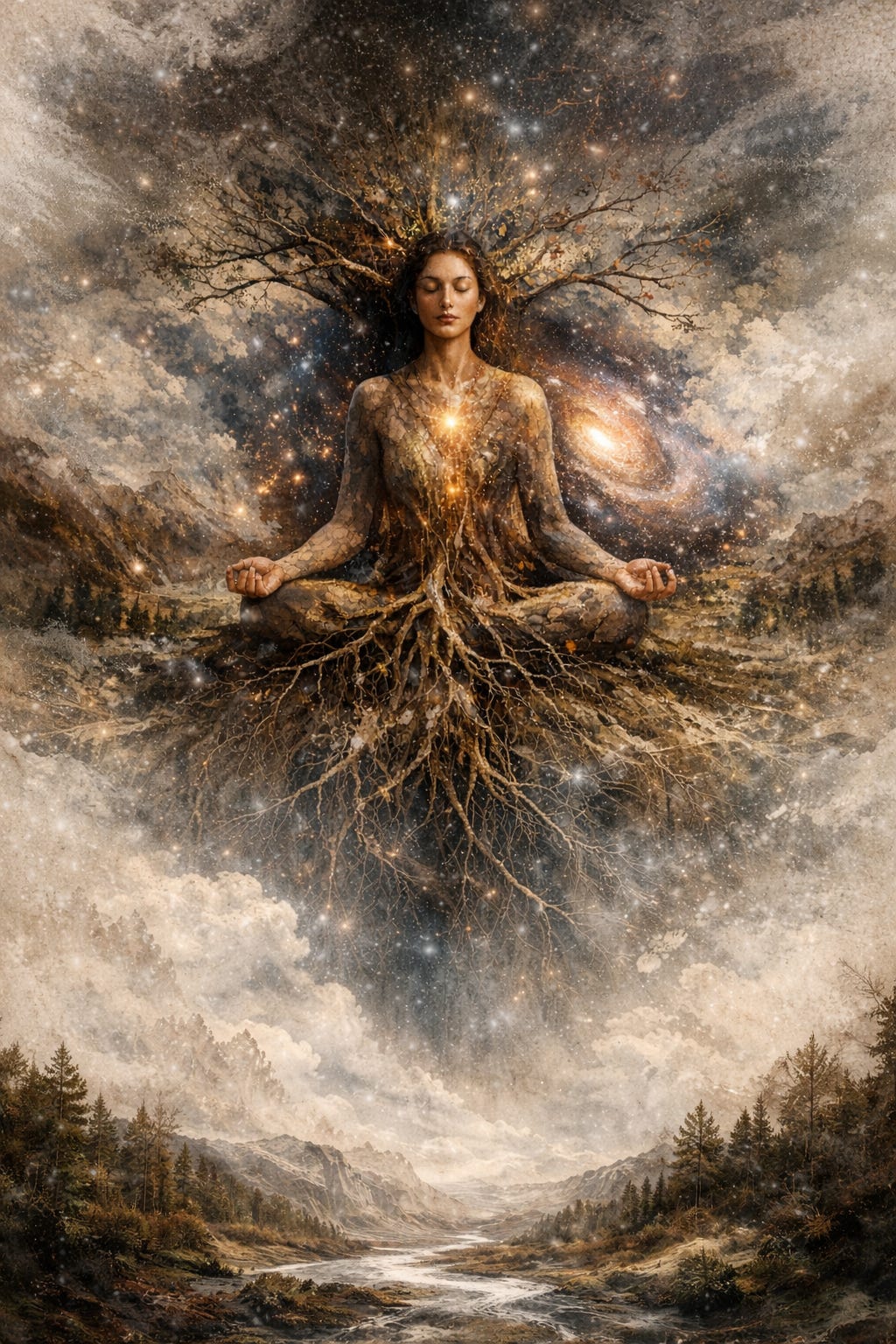
By Cordula Frei
We are living in a moment in which the dominant cultural reflex, when faced with crisis, is to generate more thinking — more analysis, more models, more frameworks that attempt to map the increasing complexity of our world — and yet, despite the sophistication of these efforts, one cannot escape the quiet but persistent sense that something essential remains untouched, unaddressed, and perhaps even unseen.
Across platforms I engage for such as Parallax Media, and in the wider discourse around what has come to be called the meta-crisis, there is a growing recognition, articulated by thinkers like Daniel Schmachtenberger, that we are no longer dealing with isolated problems, but with a dense, interwoven field of systemic breakdown — ecological, technological, psychological, and civilizational — converging into a condition that cannot be resolved from within the same paradigms that produced it.
Within this field of inquiry, the notion of a “Third Attractor” has emerged as a kind of orienting hypothesis: a possibility beyond the two dominant trajectories that currently shape our imagination of the future — namely collapse on the one hand, and increasing centralization, control, and technocratic governance on the other.
And yet, the question that continues to arise for me, both in my work and in conversations such as the one I recently had with Daniela Bomatter (who has collected a amazing series of dialogue podcasts on the topic of third attractor), is whether the very mode in which we are approaching this crisis — the mode of sensemaking itself — might be part of the limitation we are encountering.
Because what if the crisis is not only a failure of systems, but a failure of perception — a failure of embodiment, of relationship, of our capacity to participate in the living world in a way that is not mediated primarily through abstraction?
The Exhaustion of the Mental Structure
Here, my work is deeply informed by the insights of Jean Gebser, who described the unfolding of human consciousness not as a linear progression, but as a series of structures — the archaic, the magic, the mythic, the mental, and what he called the integral — each with its own mode of perceiving and participating in reality.
The mental structure, which has given rise to science, rationality, and the extraordinary technological capacities of modernity, is not in itself the problem; however, as Gebser so precisely observed, it becomes problematic when it attempts to absolutize itself, when it seeks to render the entirety of reality transparent through analysis and control.
As he writes, “The deficient mental structure is one that seeks to quantify the world exclusively,” thereby reducing the richness of being to what can be measured, categorized, and managed.
It is perhaps this very overextension that we are now witnessing as crisis — not only in our external systems, but in the fragmentation of our inner experience.
And what neuroscience increasingly confirms is that integration — the movement toward wholeness — does not arise through cognitive refinement alone, but through the reintegration of multiple layers of our being: the nervous system, the body, emotional memory, relational attunement, and what might be called deeper, pre-conceptual forms of knowing.
In my own work, and particularly in my new book, this understanding becomes central: that remembering who we are is not a metaphorical gesture, but a neurobiological and existential process of re-coherence.
Encountering the Archaic: A Threshold Experience
There was a moment in my own inner work — one that could be described in Jungian language as encountering a sub-self, an archetypal presence — which I experienced as a threshold keeper.
But this presence did not belong to the psychological realm in the way we usually understand it. It carried an archaic quality, something primordial, almost geological in its depth.
And in this encounter, something in my perception reorganized in a way that I can only describe as a descent into older layers of intelligence — as if the brain itself began to access forms of memory that were not personal, but species-level, embedded in the long continuity of life.
What emerged was a radically simplified, yet profoundly alive orientation to the world: the immediacy of finding water, of making fire, of sensing warmth and cold, of standing barefoot on the earth, of perceiving the weather not as an external object, but as a participatory field in which I was immersed.
The separation between self and world softened.
And in that moment, I understood with great clarity that what we often call embodiment today is still, in many cases, subtly governed by the mental structure — it remains something we try to achieve, to optimize, to incorporate into a framework of self-improvement.
But true embodiment begins precisely where this orientation dissolves — where we no longer relate to life as something to be managed, but as something we are already part of.
Nature, Culture, and the Illusion of Superiority
In this regard, I find a certain resonance with Camille Paglia, who insists, often provocatively, that beneath the polished surfaces of culture, there remain forces that are irreducibly natural, chaotic, and beyond human control.
As she writes, “Nature is a cruel force… we are born into it, and we cannot master it,” reminding us that the human project of transcendence is always partial, always fragile.
And yet, where I would extend this insight is toward a more relational understanding: not simply that we are subject to nature, but that we are participants within an ongoing evolutionary process that exceeds us.
To recognize that we are not the crown of evolution is not to diminish the human, but to situate it more truthfully within the vast unfolding of life.
And from this recognition, a different quality of humility — and perhaps of belonging — becomes possible.
From Sensemaking to Participation
It is here that the discourse around the Third Attractor begins to shift in meaning.
If it remains at the level of systems design, of governance models, of cognitive coordination, it risks reproducing the very logic it seeks to transcend.
But if we understand it as a transformation in the way we inhabit reality — as a movement from abstraction to participation, from control to relationship — then it becomes something else entirely.
Not a structure we build, but a field we enter.
The Return of the Feminine and the Memory of Cycles
This movement inevitably brings us to what I would call the return of the feminine — not as a sociopolitical category, but as a principle of life itself, a mode of intelligence that is cyclical, relational, and deeply attuned to processes of gestation, dissolution, and renewal.
In my book, I speak particularly to women, not because men are excluded from this process, but because the female body carries a more immediate and tangible resonance with these cycles — through menstruation, birth, menopause, and the many thresholds that mark a life lived in rhythm with itself.
And yet, what we see today is a profound exhaustion.
Women, and with them the culture at large, are often disconnected from the very rhythms that sustain them — having lost the rituals that once accompanied transitions, that once held the passages between phases of life, that once allowed for regeneration, withdrawal, and re-emergence.
We no longer know how to mark thresholds.
We no longer know how to accompany birth or death in a way that honors their depth.
We no longer know how to rest.
This leads to a Civilization Without Return
Instead, we have created a civilization oriented toward extraction — a mode of being that takes without returning, that produces without regenerating, that consumes without listening.
And both the human body and the Earth body are showing the consequences of this imbalance.
The female body is exhausted.
The Earth is depleted.
And as long as the feminine — understood as the capacity to live in cyclical relationship with life — remains unremembered, no technological innovation, no intellectual refinement, no systemic intervention will be sufficient.
Because what is broken is not only structural.
It is relational at the most fundamental level.
The Third Attractor as Regenerative Remembering
Perhaps, then, the Third Attractor is not something we invent, but something we remember.
A remembering of what it means to live as part of a living system, rather than as its master.
A remembering that life unfolds in cycles — of growth and decay, of activity and rest, of emergence and dissolution — and that to participate in these cycles requires a different kind of intelligence, one that is not driven by accumulation, but by reciprocity.
This remembering also demands a profound shift in identity.
The narrow, egoic, possessive mode of being that has dominated much of human history — this constant orientation toward control, ownership, and extraction — cannot simply be refined, it must, in some sense, break open.
And this breaking open often begins in a place of humility, of not knowing, of recognizing our dependence on forces that sustain us without our command.
From this recognition, gratitude becomes possible.
And from gratitude, a different way of living can emerge.
Re-Entering the Living World
Perhaps the question we are facing is not how to design a better future, but whether we are willing to re-enter the living world as participants rather than controllers.
To listen again — to the body, to the Earth, to each other — and to rediscover the rhythms that make life possible.
Because if we can do that, then the Third Attractor is not a distant possibility.
It is something that begins to take shape in the way we live, the way we relate, the way we remember.
And in that remembering, we may rediscover a truth that is both simple and profound:
That to be human
is not to stand above life,
but to belong to it.”
About:
Cordula Frei is an author, spiritual teacher, and senior practitioner of Voice Dialogue whose work explores the intersection of consciousness, embodiment, deep ecology, and cultural transformation. Her inquiry is rooted in the question of how human beings can re-enter a living relationship with themselves, with each other, and with the Earth in times of profound civilizational transition.
Drawing from neuroscience, archetypal psychology, and the philosophy of Jean Gebser, Cordula’s work points beyond purely cognitive modes of knowing toward a more integrated, embodied, and relational intelligence. Her approach weaves together ritual practice, somatic awareness, and ecological sensibility, emphasizing the importance of thresholds, cycles, and the reactivation of deeper layers of human experience.
Through her books — including Alchemy of Soul, Soulskin, and Wild & Wunderbar — as well as her teaching, writing, and public dialogues, she contributes to an emerging field of inquiry that engages the meta-crisis not only as a systemic challenge, but as a transformation of consciousness itself. Her work is closely connected with Parallax Media, where she hosts conversations and develops formats that explore new ways of thinking, sensing, and relating in a complex world.
Cordula lives and works in close relationship with the landscapes of the Black Forest and the Vosges, where her practice is grounded in direct engagement with the living world.
Podcast & Media
Roots of Enlivenment (Podcast)
A Parallax Media series hosted by Cordula Frei, exploring embodiment, consciousness, ecology, and cultural transformation through in-depth conversations and reflections.
https://www.parallax-media.com/roots-of-enlivenment
Talks, Podcasts & Conversations (Collection)
A curated overview of Cordula Frei’s public dialogues, interviews, and podcast appearances.
https://cordulafrei.substack.com/p/talks-podcasts-and-conversations
Selected Works & Links