
Walking back Into the Wild Soul
Soulskin, Wonder & the Return of the Instinctive Feminine

On Women, Wilderness, Archaic Memory, Neuroregulation, and the Forgotten Skin of the Soul
Reflections from Roots of Enlivenment
There are conversations that do not arrive as information but as atmosphere, sensation, and texture—experiences that enter the body before the intellect has time to arrange meaning around them.
My conversation with Debra Ogilvie-Roodt from Women Wonder Wild unfolded in precisely this way, slowly surrounding me with the scent of wet earth after rainstorms, with the dense soundscape of insects and distant birds moving through Zimbabwean dusk, with the mist of Victoria Falls settling softly against skin, and with the strange and almost forgotten feeling that the human nervous system itself may once have evolved in intimate reciprocity with landscapes rather than in permanent separation from them.
Long after the recording had ended, I could still feel the cadence of Debra’s presence lingering somewhere within me, almost as if the conversation itself had become part wilderness encounter, part remembering, part initiation into questions that modern culture rarely gives women space to ask openly anymore.
What does it truly mean to enter into intimate relationship with the land, as Debra described so beautifully throughout our dialogue, and what begins shifting within the female psyche once the body no longer moves through nature merely as observer, tourist, consumer, athlete, or spiritual seeker, but instead begins listening to land as if it were alive, responsive, intelligent, and mysteriously capable of reflecting back hidden dimensions of one’s own interior world?
Could it be that many women today are not only exhausted from overwork, overstimulation, emotional labor, and the fragmentation of modern life, but are carrying a much older fatigue born from centuries of adaptation away from instinctive forms of knowing that once connected psyche, body, ritual, land, dream, myth, sensuality, community, and ecological belonging into one participatory field of experience?
Again and again during our conversation I found myself returning inwardly toward those periods in my own life where I did not yet understand that I was crossing a threshold because no elder had named it, no culture had prepared me for it, and no ritual structure existed to hold what was quietly dissolving underneath the visible surface of identity.
There had simply been a growing feeling that the life once organized around coherence no longer fit the movement of the soul itself.
And perhaps this is precisely where wilderness begins entering the human story differently, not as escape from civilization alone, but as teacher.
Once the body spends enough time listening to rivers, horses, trees, insects, weather patterns, silence, darkness, stars, animal movement, distant thunder, changing temperatures, and the subtle shifts of one’s own breathing while walking through untamed landscapes, perception itself begins reorganizing in ways modernity rarely understands.
Time slows differently there.
Attention softens outward again.
The nervous system stops orienting exclusively through urgency and management.
The senses widen.
The body remembers participation before the mind can conceptualize it.
And perhaps this is why Clarissa Pinkola Estés wrote so insistently about what she called the “wildish nature” within women, describing not a romanticized rebellion against culture, but a deep instinctive intelligence rooted in cyclical knowing, embodied intuition, sensory perception, imagination, eros, emotional truth, and relational participation with life itself.
Listening to Debra describe women standing before waterfalls while rainbow mist moved through sunlight and the roar of water entered the whole organism almost physically, I began wondering whether awe itself may once have functioned as a central mode of cognition within human cultures before modern consciousness reduced reality primarily to productivity, abstraction, control, and measurable outcomes.
Could wonder itself reorganize the nervous system away from survival fixation?
Could beauty soften the hypervigilance through which so many modern identities are unconsciously organized?
Could intimacy with wilderness awaken archaic layers of consciousness still living quietly beneath domesticated culture, waiting patiently for the conditions under which they might become perceptible again?
Jean Houston once spoke about the possibility that modern humans dramatically underestimate the latent capacities hidden within consciousness itself, and throughout this conversation I found myself sensing how often women in particular arrive at wilderness thresholds carrying unexplored psychic territories within them that only become accessible once ordinary social identity begins loosening its grip.
Because what happens to a woman once she no longer experiences herself primarily through usefulness, performance, adaptation, or social legibility, but instead begins sensing herself through rhythm, sensuality, intuition, instinct, imagination, grief, eros, silence, and direct participation with the more-than-human world?
What forms of intelligence begin surfacing there and what memories return through scent, touch, darkness, dream, movement, animal presence, and sensory immersion?
In my book Soulskin, I once wrote:
“Sie war dem unwiderstehlichen Ruf nach Bewegung immer hörig gewesen, bereit alles hinter sich zu lassen, was sie oder den Andern in Erstarrung zu bringen drohte.”
“She had always remained loyal to the irresistible call toward movement, ready to leave behind everything that threatened to freeze either herself or others into lifelessness.”
This passage remained with me throughout the entire dialogue because so many women today seem to stand exactly within this tension between adaptation and aliveness, between social coherence and instinctive truth, between externally constructed safety and the deeper embodied belonging that only becomes possible once the soul no longer abandons itself in order to remain acceptable.
Perhaps this is also why the old Inuit story of the seal skin woman, the Selkie, continues haunting the female psyche across generations and cultures.
The woman who removes her sealskin in order to enter the human world, only to slowly realize that separation from her instinctive nature eventually becomes unbearable.
The woman who one day begins searching again for the lost membrane between body, instinct, sensuality, mystery, and belonging.
Could it be that many women today are searching less for reinvention than for recovery?
Less for empowerment than for remembrance, for reunion with something ancient within themselves that modernity taught us to distrust?
Camille Paglia once observed that civilization itself often depends upon the containment of elemental and chthonic energies associated historically with nature, eros, cyclical life, sensuality, and the feminine psyche, and perhaps one of the great unspoken tensions of our time emerges precisely here:
the growing exhaustion produced when human consciousness becomes too separated from the archaic and instinctive layers from which meaning, imagination, ritual, creativity, sensuality, and participation originally arose.
Could this also explain why so many women now feel drawn toward forests, horses, grief and transition rituals, oceans, wilderness journeys, embodiment practices, myth, slowness, circles, sensory life, ancestral memory, gardening, dance, pilgrimage, and direct relationship with land itself?
Not because they wish to abandon culture entirely, but because something within the organism is attempting to restore relational coherence after centuries of fragmentation.
Even the ancient Australian tradition of walkabout begins appearing differently through this lens once one stops understanding movement merely as physical travel and instead senses how land itself can function as memory, orientation, initiation, cosmology, story, nervous system regulation, and participatory intelligence.
The archaic brain never disappeared beneath modern civilization at all, it simply became quieter beneath the noise.
Wilderness offers conditions through which older perceptual pathways slowly reactivate again:
through rhythm,
through silence,
through danger,
through awe,
through darkness,
through stars,
through sensory intimacy,
through the body remembering itself as part of a living world rather than separate observer standing outside it.
Toward the end of our dialogue another question emerged between us and remained quietly alive long after we finished speaking:
What changes in relationship once women reclaim instinctive sovereignty and no longer abandon their own sensory truth in order to belong?
How does intimacy change once a woman trusts her body again?
How does love change once it is no longer organized around fear or adaptation?
How does speech change once silence has taught the nervous system another rhythm?
How does one walk through cities after remembering rivers?
How does one touch another body after remembering rain, horses, trees, darkness, waterfall mist, and the immense breathing silence of wilderness landscapes?
And perhaps most importantly of all:
what becomes possible for culture itself once women no longer exile the wild soul in order to survive modernity?
Author:
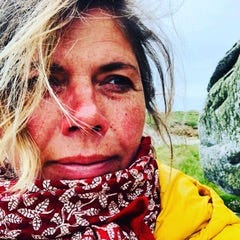
Cordula Frei is a writer exploring the intersection of myth, embodiment, psychology, and ecological consciousness. Her work focuses on the relationship between the nervous system, feminine archetypes, and the return to instinctual intelligence in modern life.
Debra Ogilvie-Roodt:
Debra’s work invites women back into embodied connection with land, rhythm, and intuition, weaving together nature-based wisdom, feminine archetypes, and experiential learning in wild landscapes. She is founder of Women Wonder Wild, creating wilderness-based experiences and spaces for feminine embodiment, nature connection, and transformational inquiry in Southern Africa.
You can explore her work here, book amazing wilderness travels and walkabout and meet her on request:
https://www.womenwonderwild.com/
Cordula Frei on Substack
Listen to the conversation on Roots of Enlivenment:
https://www.parallax-media.com/roots-of-enlivenment